
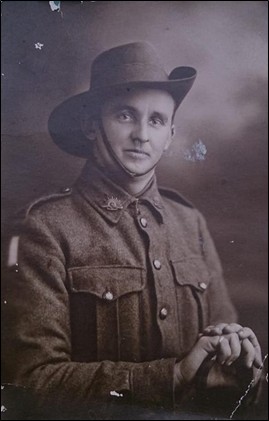
Denmy, Gulargambone, NSW
1639
45th Battalion,
Tooraweenah Kookaburra
RTA 4.4.1919
Private Andrew Ferguson was a 25 year old grazier of Gulargambone when he enlisted on 12 January, 1916 with the Tooraweenah Kookaburras and marched to Bathurst.
Andrew was born in Gulargambone, eighth child of Sarah and John Ferguson, his mother was his stated next of kin when he enlisted. His medical examination described him 5’7” tall, 123lbs (56kgs), chest expansion of 32”, a fresh complexion, blue eyes, fair hair and no distinctive marks. He was Presbyterian.
After training at Bathurst, Andrew embarked at Sydney on HMAT Ceramic on 14 April, 1916. The 45th Battalion trained in Egypt before they left for England. He arrived in France in September 1916 and was wounded in action when he was struck by a shell on 17 November, 1916. The unit was at the front near Bernafay Wood and experiencing the worst of a cold wet autumn with very little shelter and up to their knees in mud. Andrew was struck on the hand and complained of a swollen neck. He was described as ‘excited but not dazed’; aphonic (unable to talk) for three months, headaches, tremors, giddiness, epileptic attacks and cardiac symptoms. His final diagnosis was shell shock. He was sent back to England for treatment and convalescence, via the 36th Casualty Clearing Station, and the 10th General Hospital at Rouen. He spent December 1916 to February 1917 in the London General Hospital at Chelsea and the 3rd Auxiliary Hospital at Wandsworth.
Andrew kept a daily diary, even though it was forbidden. It gives an insight into the daily lives in training and in the field in France and Belgium. From an entry dated 16 December 1916;
Had a very rough time in France, nearly always had wet clothes & mud & plenty of times not enough to eat. ….. I was only in two battles, it was murder. The cries of the wounded is something terrible. …… I have had the greatest trouble out to keep this diary in France. They will court martial you if they catch you,
Andrew was sent back to Australia on HMAT ‘Themistocles’ , arriving on July 4,1917, and he was discharged 3 August, 1917.
A report of the welcome home given to Andrew and another soldier C Curtis was in the Gilgandra Weekly 24 August, 1917. After speeches the men were given a gold medal in appreciation of their loyalty to King and country.
He was issued the British War Medal and the Victory Medal
Andrew died 30 June 1963 and is buried in the Gulargambone Cemetery.