Mountain View, Biddon via Gilgandra, NSW
4802
13th Battalion, 4th Machine Gun Battalion
Gilgandra Coo-ee
RTA 13.4.1919
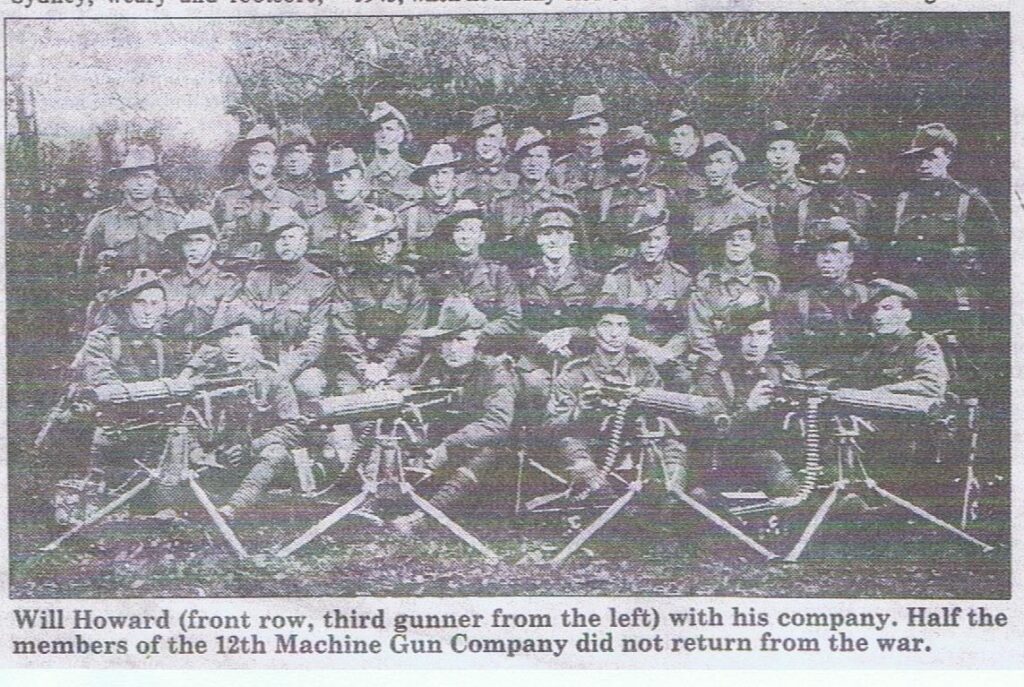
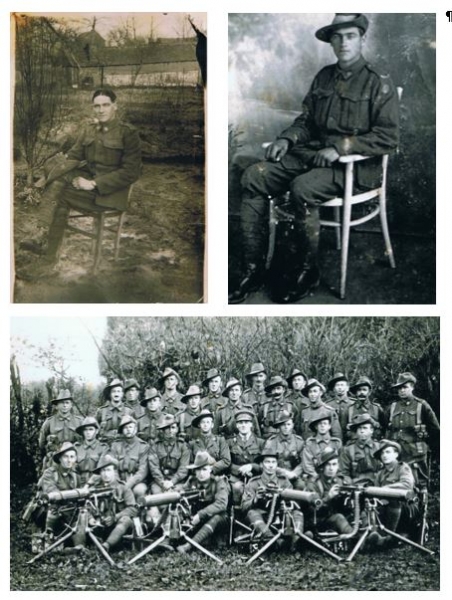
Lance Corporal William John Luther Howard 4082
William Howard was a 24year old farmer when he was passed physically fit by Dr Peet of Gilgandra on 26 October 1915 and joined the Cooee March at Bathurst. He was described as 5’9” tall (1.75m), 11stone 2lbs (70kgs) with a dark complexion, light blue eyes, brown hair and religion, Methodist. He had a faint scar on the outer side of his right forearm, one across his left foot and inner side of right knee, an oval scar on his left buttock and thickening of the middle shaft right femur from an old fracture. William was born at Crookwell, NSW and on enlistment he lived at ‘Mountain View’ Biddon via Gilgandra with his parents, John and Mary Howard. He stated he had no previous military service.
The Cooees marched to Sydney and joined the 13th Battalion. They trained at Liverpool, NSW and embarked at Sydney on the “Star of England’ on 8 March 1916 and arrived in Egypt on 11 April 1916. After a time in No2 Australian General Hospital for mumps, William was transferred to the 45th Battalion and left for France.
William arrived at Marseilles, France on the ‘Huntspell’ in June 1916 and from there he went to Etaples to the Machine Gun School, training from June to August 1916.
He was taken on strength on 15 August 1916 with the 12th Machine Gun Company when it was involved in heavy fighting around Pozieres. On 1 January 1917 1 he was seen at a Casualty Clearing Station. From there he went through the NZ Stationary Hospital at Amiens with Influenza and recuperated at Rouen, France. He rejoined his unit on 27 January 1917
While the unit was at Ypres Belgium, William was promoted to Lance Corporal. on 9 October 1917.
The 12th Machine Gun Company was redesignated the 4th Machine Gun Battalion on 1 April 1918
From 16 to 25 August 1918, William was sent to the 4th Army Rest Camp at Longeau Belgium
William was with the unit in the field at Longeau, from the 25 August 1918 to 7 September 1918, when he went on leave to the UK. William rejoined the unit from 26 September to 20 October 1918.
From 20 October to 26 October 1918, he was detached to the Australian Corps Gas School and rejoined the unit from 26 October 1918
On the 10 February 1919 he returned to England to commence his return to Australia.
William returned to Australia via Cape town, South Africa, on the ‘Commonwealth’ from 13 April to 19 May 1919. He was discharged on the 27 July 1919 after serving 3 years and 97 days overseas. He received the British War Medal and the Victory Medal.
Two of his brothers also served; Frederick Stanley (Stan) in the 9th Australian Light Horse and Arthur Clifford (Cliff) worked in munitions in England. Cliff was the inventor of the Howard Rotary Hoe.
After returning from the war, William named his property ‘Passchendaele’, in a tribute to the many friends he lost there. He married his sweetheart, Minnie Fenton, and they had eight children. He died aged 52 due to the effects of the war and is buried in Gilgandra Cemetery with his wife.