
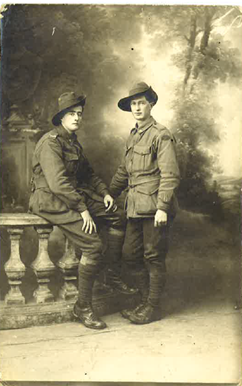
Wingadee, Coonamble. NSW
4806
13th Battalion, 15th Reinforcement
Gilgandra Coo-ee
RTA October 1917
Private Jack Henry Hunt 4806, Private William Laurence Hunt 4805 and Charles Henry Hunt 4804
Jack Henry Hunt 18 years, and his brother, William Laurence Hunt, 20 years, were labourers from ‘Wingadee’, Coonamble NSW when they enlisted in Gilgandra on 9 October 1915 with the Coo-ee Recruitment March. When their father, Charles Henry Hunt heard that they had enlisted, he caught up with them at Raglan and enlisted himself.
Charles Henry Hunt was a 43 year old widower, his wife Ellen died in 1902. His daughter, Pearl Olive Hunt was his next of kin and living at the Convent in Dubbo. Charles Hunt was 6’1” tall, 176lbs (79kgs), Medium complexion, blue eyes, brown hair, and religion was Catholic.
William was 20 year old labourer when he enlisted at Gilgandra on 9 October 1915. He was 5’10” tall, 10st 12lb (65kgs) with dark complexion and hair; hazel eyes and a small scar from right shin. He was examined by Dr Peet of Gilgandra.
Jack Henry Hunt was an 18 year-old station hand when he enlisted on 9 October 1915 at Gilgandra. He was 5’ 10 ½” tall, 10st 7lb (67kgs), with dark complexion and hair; hazel eyes and a faint scar below R knee.
The men marched together with the Cooees to Sydney to train at Liverpool. They embarked to Egypt aboard HMAT A15 Star of England on 8 March, 1916 with the 13th Battalion. All three transferred to the 45th Battalion and arrived in France at the Western Front in June 1916, facing Pozieres and Mouquet Farm as part of the Battle of the Somme in August 1916.
Charles suffered shell shock and bruises in August 1916 but remained on duty. In October 1916, he was admitted to hospital in England with pleurisy and returned to Australia on the Beltana. Charles was discharged permanently unfit for active service in February 1917 and received a pension of 15 shillings per fortnight. He died in a motor car accident on 17 February 1930 and is buried in Macquarie Park Cemetery at North Ryde NSW. The vehicle was driven by Mr Sidney Bennett, a fellow Coo-ee marcher. Charles lived at ‘Avon’, Coonamble.
William was on active service at the front when he was wounded but stayed with his unit until he was admitted to hospital in November 1916 with “trench foot” (frost bite). He remained in England, convalescing at the command depots at Perham Downs and Weymouth. In November 1917 he attended the Winchester Engineering Works for a course. William appears to have remained in England until he returned to Australia aboard the Runic on 22 September 1918. He was discharged in Sydney on 31 January 1919. William died in 1977 and is buried in Dubbo.
Jack was admitted to hospital in March 1917 with “trench foot” (frost bite) and transferred to England to the 2nd Southern Hospital and then to the 3rd Auxiliary Hospital in Dartford England. His toe was eventually amputated and Jack returned to Australia on 19 October 1917 by the hospital ship Lyttleton for three months change. But he never returned to the Western Front. He was discharged medically unfit on 28 January 1918 in Sydney. Information about his life and death after the war will be appreciated.
John Meredith’s book ‘The Cooee March’ tells the story that Charles said they won’t be short of a feed because they are good shots with a rifle. Jack and William were together on the Western Front on September 9 1916 when they were both fined one days pay for the offence of ‘eating ration without permission’. They must have gone hungry that day!
They all received the British War Medal and the Victory Medal. William and Jack are commemorated on the Cooee Gateway in Gilgandra.
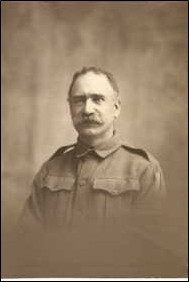
Charles Henry Hunt (courtesy Di Ashton)