
Collie NSW
1663
45th Battalion,
Tooraweenah Kookaburra
RTA 24.8.1918
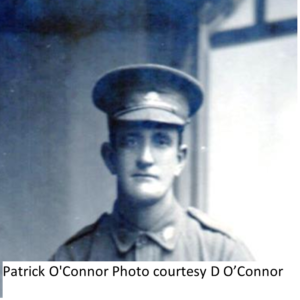
Patrick and Michael O ‘Connor joined the Tooraweenah Recruitment March on 12 January 1916 and marched 378 kms to Bathurst. Their story cannot be told without including their brother, George O’Connor, who joined them soon after they arrived at Bathurst. A fourth brother, Edmund Joseph O’Connor enlisted in August 1917, aged just 19years old and is also part of their story.
Mrs Caroline O’Connor of Collie NSW saw four of her sons enlist in World War One and march away to endure the hardships of the Western Front. Only three returned to Australia. The boys were single and worked on the family farm at Collie NSW. Their mother was their next of kin as their father; William O’Connor had died in 1913.
Patrick, Michael and George trained at Bathurst until 29 March 1916 and embarked for Egypt on the ‘Ceramic’ on 14 April, 1916. With the 45th Battalion. After training in Egypt, they embarked at Alexandria on the ‘Francona’ and arrived at Plymouth England, on 16 June 1916. They left for France on 9 September 1916 and joined their unit, the 45th Battalion on 20 September 1916 in Belgium.
—————
Patrick O’Connor was a 31 year old farmer of Collie NSW when he joined the Tooraweenah Kookaburra Recruitment March on 12 January, 1916. Michael and Patrick had served with the local 9th Light Horse CMF in Gilgandra NSW.
The medical examination described Patrick as 5’9”; 173 lbs (78kgs), chest expansion 36”-39”, dark complexion, brown eyes, dark brown hair, a scar on the right side of his back and a Roman Catholic.
Patrick joined his unit, the 45th Battalion, on 20 September, 1916 in Belgium. He experienced the cold wet winter and in December 1916, he was sick and admitted to hospital until June, 1917. He was sent to England for treatment for Nephritis, an inflammation of the kidneys. Patrick rejoined the unit when it was in Ottersteen, France but a month later he was in hospital for two weeks suffering from Trench Fever, a disease caused by body lice, a common disease in trench warfare. Patrick enjoyed his leave in England in January 1918.
On 30 March, 1918 Patrick was sent to hospital with Pleurisy with Effusion, a lung disease. He was admitted to Manor Court Hospital at Folkstone, the 3rd Auxiliary Hospital at Dartford, the Military Hospital at Shorncliffe and then the No2 Command Depot at Weymouth. Patrick did not return to France again. He commenced his return to Australia on the Hospital Ship ‘Medic’ on 20 August, 1918 and disembarked in Australia on 9 October, 1918. Patrick was discharged on 8 February, 1920. He was issued the British War Medal and the Victory Medal.
Patrick married Olve Paton in Gilgandra in 1920. They had eight children. Patrick died 14 July 1940 in Randwick Hospital and is buried in the Macquarie Park Cemetery at North Ryde.
Patrick is commemorated on the Collie NSW War Memorial.